
3 Web3 Marketing Metrics Every Founder Must Track
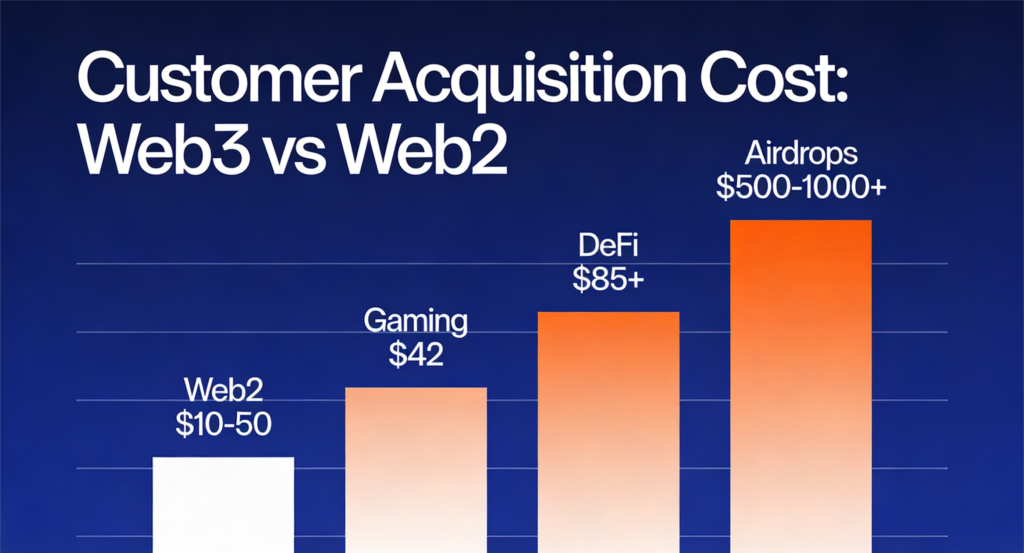
A 2025 blog on formo.so about crypto startups struggling with CAC, reported that DeFi protocols burn through $85+ per user acquisition. Gaming projects face $42 per player. Airdrop campaigns hemorrhage $500-$1,000+ per retained user.
While traditional Web2 companies spend $10-50 per user, Web3 projects are drowning in acquisition costs without knowing whether those users stick around long enough to justify the spend.
According to the 2026 User Acquisition Trends Report by Blockchain-Ads, community-led initiatives can lower CAC by fostering strong brand loyalty early on, but most founders never calculate the baseline they’re trying to improve.
The difference between growing and gambling comes down to three metrics: Customer Acquisition Cost (CAC), Lifetime Value (LTV), and the ratio between them.
Customer Acquisition Cost tells you what you’re really paying.
Not all users cost the same to acquire. Cost per wallet ranges from $1.86 to $15, depending on targeting sophistication, according to HypeLab’s 2026 crypto advertising benchmarks. A sign-up from an influencer campaign costs differently than a referral from your existing community.
Averaging CAC across all channels hides reality. You need CAC broken down by source so you know which channels deliver quality users and which ones burn budget.
The formula is simple: Total marketing spend divided by the number of new users acquired. $10,000 on a KOL campaign acquiring 150 wallet connections equals $66.67 CAC per user.
Lifetime Value tells you what each user is actually worth.
Acquisition means nothing if users leave after one transaction. LTV measures the total revenue a user generates over their entire relationship with your platform.
For Web3, this includes transaction fees, staking rewards, NFT royalties, trading volume, governance participation, and any value that accrues from user activity. Calculate it by multiplying average revenue per user by average customer lifespan.
If your average user generates $200 and stays active for 8 months, your LTV is $200. If LTV is declining over time, your retention is broken and you’re acquiring users who don’t stick around.
LTV:CAC ratio tells you if scaling will accelerate growth or accelerate losses.
This single number is the health check for your entire growth strategy.
The ratio is lifetime value divided by customer acquisition cost. If LTV is $200 and CAC is $50, your ratio is 4:1.
A 3:1 ratio below means you’re barely profitable, and scaling is risky. Above 3:1 means the unit economics work, and you can confidently invest more. Above 5:1 means you’re underleveraged and should be spending more because the math works strongly in your favor.
The common pattern across Web3 projects: founders know their monthly marketing spend and know user growth, but have never calculated whether the relationship between those two numbers is sustainable.
Optimizing for vanity metrics, such as follower count, wallet connections, and transaction volume, creates the illusion of progress. Those numbers look good in pitch decks, but don’t tell you if your business model works.
$100,000 on influencer campaigns, acquiring 2,000 users who churn after one transaction, means CAC is $50, and LTV is $30. That’s a $40,000 loss disguised as growth.
Before you spend another dollar on paid ads or influencer campaigns, answer three questions: What’s my CAC by channel? What’s my LTV? Is my ratio above 3:1?
If you can’t answer all three, you’re not ready to scale. You’re ready to measure.
Sources:
- Why Crypto Startups Struggle With High CAC, Formo (October 2025)
- Crypto Ad Benchmarks 2026, HypeLab (March 2026)
- User Acquisition Trends 2025-2026, Blockchain-Ads (March 2026)


